Overview
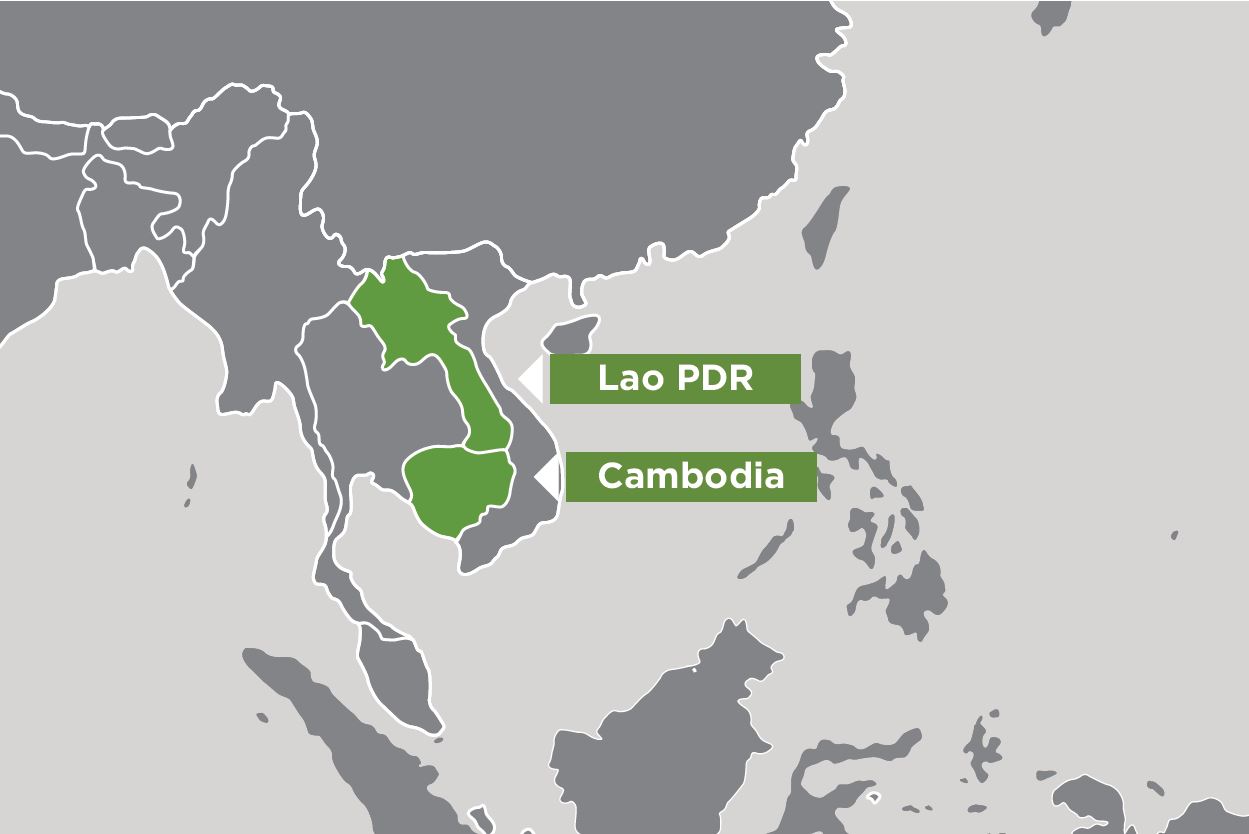
This project aimed to improve the profitability of lowland, predominantly rice-based farming systems in Cambodia and Laos by conducting research that leads to increased resilience of crop and livestock production through improved forage and fodder production and improved use of water and nutrients.
Despite making steady progress in reducing poverty, Laos remains one of the world’s least developed countries, with an estimated one-third of the population (2 million people) living below the poverty line.
Similarly, Cambodia has made considerable progress in raising living standards, but it remains one of the poorest countries in South-East Asia. About one-quarter of its population lives in poverty, of those, 90% live in rural areas.
Agricultural profitability in Laos and Cambodia can be improved through greater intensification and integration of crop and livestock systems.
This research evaluated limitations to crop and forage productivity and explored the potential to intensify systems through innovations and technological solutions. In addition, the project aimed to identify community-endorsed opportunities for intensification of systems at both the farming system and community scales.
Expected project outcomes
- 200 farming households benefiting from intensification of livestock in principally cropping-based systems.
- Greater resilience in smallholder farming systems and increased profits for smallholder farmers in Laos and Cambodia.
- Improved productivity, efficiency and sustainability of fodder production leading to improved gender equity within households and improved livelihoods.
- Increased farm income providing higher standards of living, with greater resources directed towards meeting education and health needs.
- Increased farm income to provide household needs, reducing the need for off-farm income and family fragmentation and strengthening the social fabric of rural communities.
Summary of outcomes to date
2021–22
Despite the challenges of COVID-19, Phase 2 of Forage Options has used existing networks with capable international partners in Cambodia and Laos to continue long-term experiments from the first phase and implement new research activities. This has been aided by communication through weekly zoom meetings.
In Laos, a fertiliser rate and liming experiment was implemented at the NAFRI Livestock Research Center. Preliminary analysis of the results to date indicate it will effectively demonstrate the importance of sustainable K management for highly productive forages and the yield benefits of liming acid sands for forage production. The team has prepared demonstrations of the benefits of improved nutrient management on forage production on smallholder farms in Cambodia and Laos during the 2022 wet season.
Long-term soil moisture monitoring research across landscapes commenced in 2018 and has been maintained in two provinces of Cambodia. Preparations are being made to collate data from this work, and some sites will continue to participate in research into soil management for forage growing.
The project continues to explore socioeconomic barriers to forage production and promotion, with a survey of 120 smallholder farmers in Cambodia conducted to explore the relationship between labour and forage investment and the economic benefit of labour savings created by forage adoption. A forage planting material supply chain study is ongoing, with preliminary ‘maps’ developed for the supply chains in Kampong Speu and Takeo Provinces, Cambodia. In the coming year, the project will explore potential opportunities for developing these supply chains.
2022–23
In Laos, a fertilizer rate and liming experiment has been running for 20 months at the NAFRI Livestock Research Center. A preliminary report has been prepared on the results to date. These results to date indicate the importance of K management for highly productive forages and the yield benefits of liming acid sands for forage production, neither of which is widely practiced. Working with local researchers and students, the team has implemented demonstrations of the benefits of improved nutrient management on forage production on smallholder farms in Cambodia and Laos during 2022, which have continued to the present. These have maintained the project's connection with practicing farmers in the target areas, provided opportunities to local students for Master’s research, and produced locally relevant demonstrations of forage management for high productivity.
Long-term soil moisture monitoring research across landscapes in Cambodia commenced in 2018 and has been concluded in the current reporting period. Researchers are working with a spatially and temporally complex dataset to identify key findings and to identify how variations in landscape impact forage management.
Extension and outreach — The project is exploring the use of short promotional and instructional videos in the local language, and, where possible, presented by farmers, for farmers. Video production in Cambodia is now well underway. To date, the main steps have involved: determining the audience and suitable format e.g., video length, file size, content delivery mode; script development for 5 videos; and, 4 days of filming in Kampong Speu Province. The 5 videos cover: 1) why grow forage; 2) how do you grow forages; 3) where should you grow forages; 4) how do you manage forages; 5) how do you use forages. Editing is underway with an expected delivery date of early August 2023. The videos will be uploaded to the project's Facebook page and YouTube.
Research and capacity-building — Research and capacity-building outputs continue to be strong. The return of John Allwright Fellow Dr Huot Chanthy from the Royal University of Agriculture in Cambodia has been a boon to the project as he has taken responsibility for the management of fieldwork in Kampong Speu province as a capable partner. Meanwhile, John Allwright Fellow Ms Manithaythip Thephavanh has recently qualified for the award of her PhD with the University of Adelaide, producing 3 relevant papers about the engagement of youth in agriculture in Laos. A new John Allwright Fellow, Koun Pengly, began studying with the University of Adelaide in July 2023.