

Nepal
Previous India
Image
Image
 Next Pakistan
- File

Agriculture is the largest sector of the Nepalese economy, employing more than 60% of the total population and contributing about 24% of GDP.
While agriculture is the main contributor to livelihoods, it has a very low growth rate because of low levels of technology and infrastructure and poor market facilities. With most members of rural households abroad for foreign employment, remittances have become a major part of the national economy – estimated to account for 26.6% of the country’s GDP in 2023.
Nepal is susceptible to geological and climate-related disasters. Weaknesses in effective response mechanisms and strategies for dealing with natural hazards has historically exacerbated these vulnerabilities, especially for people living in the higher altitudes who rely on subsistence farming.
The agriculture sector is dominated by subsistence farming resulting in low productivity and production of agricultural commodities. As a result, the country relies heavily on imports of agricultural commodities, mainly from India. The Global Hunger Index classifies Nepal as ‘moderately’ food insecure.
About one-third of Nepal’s total area is forested and most of this area is government owned. In spite of overcutting and poor management, timber is one of the country’s most valuable resources and potentially a major source of revenue.
Partnering with Australia
Australia and Nepal will celebrate 65 years of diplomatic relations in 2025. In 2023–24, Australia provided an estimated A$27.2 million in official development assistance, focused on governance, climate and disaster resilience, gender equality and social inclusion.
The Nepal Agriculture Research Council, the apex body for agricultural research in the country has been an ACIAR partner in many projects over the years. Nepal also hosts an important regional research body – the International Center for Integrated Mountain Development. Australia’s long-term support for community forestry in Nepal since the 1960s, through AusAid and ACIAR, has contributed to around 45% forest cover in Nepal.
Country priorities
Increased farm and forest productivity remains a core priority of Nepal for collaboration with ACIAR to improve food and nutrition security of the rural poor. In the Middle Hills districts, where the impacts of earthquakes and floods remain, our program focuses on, at the request of the Nepalese Government, research to support increased timber production from community forests.
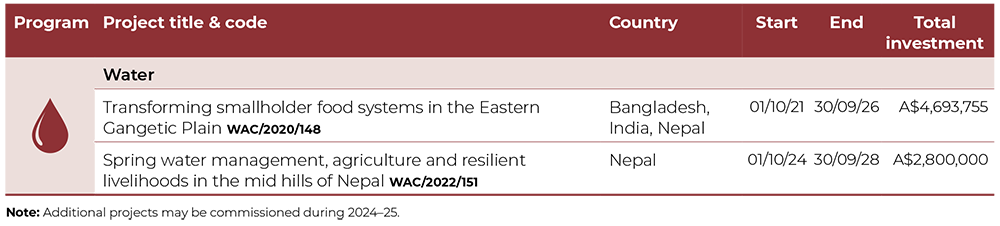
Given the common agricultural production challenges across the alluvial plains of Nepal, eastern India and Bangladesh, cooperative research linkages with neighbouring countries will be explored further. The focus will be on understanding pathways to crop diversification to reduce inequity, production risk and unsustainable resource use. In addition, the program will also attempt to improve spring water management in the mid-hills of Nepal, which will improve inclusive and resilient rural livelihoods. These priorities address key issues such as climate change, nutrition and declining water availability.
ACIAR supports the development of scientific, leadership and management capacity of research partners in Nepal through fellowships and programs of the ACIAR Capacity Development Program. During 2024–25, ACIAR will engage alumni from Nepal in regional alumni activities to focus on meaningful engagement and knowledge exchange.
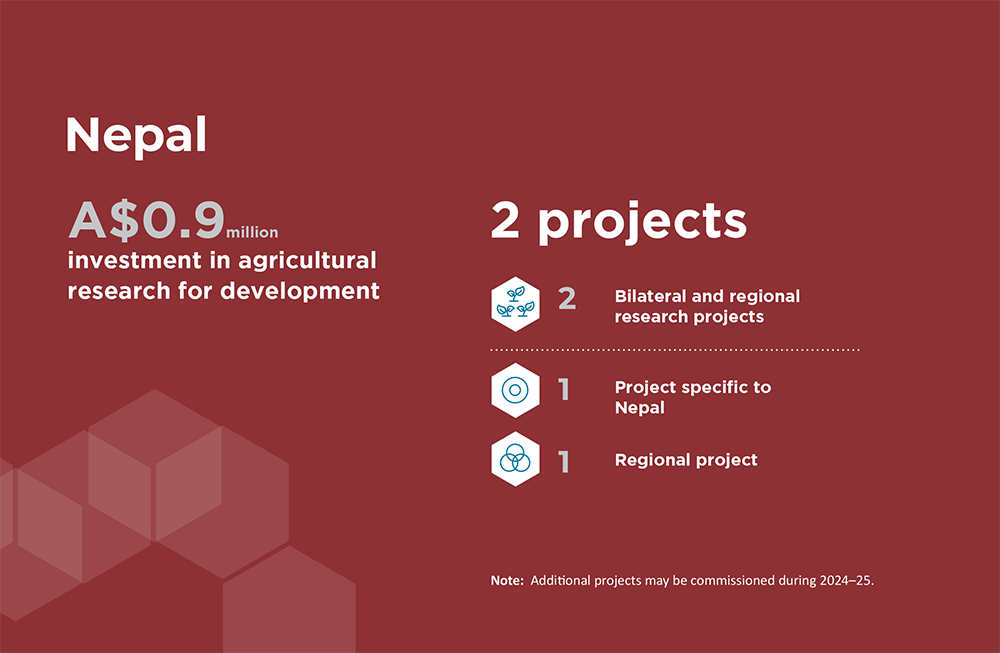
Two research-for-development projects in Nepal address high-level objectives of ACIAR and specific issues and opportunities identified by local partners.
Current and proposed projects in Nepal, 2024–25

More information about our projects is available on the ACIAR website. Search for the project title or project code.